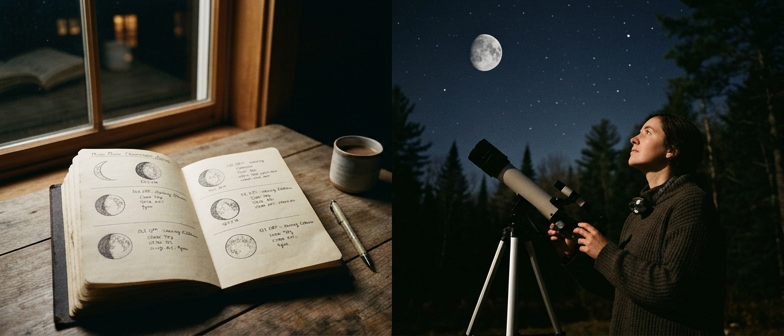
Why Keep a Moon Phase Observation Journal
A Moon Phase Observation Journal is a simple way to notice how the Moon changes from night to night and to organize what you see into a clear record. By turning casual backyard astronomy basics into regular notes, you start to recognize patterns in the Moon’s cycle, such as when it appears thicker or thinner, higher or lower in the sky. Treating your entries as a simple astronomy log helps you connect what you see with the lunar calendar you might check online or in an app, turning short moments outside into a steady habit of observing the night sky.
Keeping night sky observation notes encourages you to slow down, look carefully, and write or sketch what you notice instead of relying on memory alone. Families can use a journal to involve kids in science at home, while learners of any age can practice describing the Moon’s shape, brightness, and position using everyday language. Over time, your pages show how phases repeat and how weather, light pollution, and your viewing spot affect what you can see. This record supports at-home astronomy without special tools, using simple descriptions, dates, and occasional Moon sketches to build confidence in observing and understanding the changing Moon.
Understanding Lunar Phases and Moonrise Patterns
A Moon Phase Observation Journal becomes clearer when you know why the Moon seems to change shape. The lunar phase cycle happens because the Sun lights different portions of the Moon as it orbits Earth, creating familiar stages such as new moon, first quarter, full moon, and last quarter. A simple Lunar Phase Calendar shows this repeating pattern over about a month, so you can predict which phase to expect on a given date. In your Night Sky Observation Notes you record how bright the Moon is, how much of its disk is lit, and where the lighted edge appears, then link these details with the date and time in your Simple Astronomy Log to make comparing months of observations easier.
Moonrise Time Tracking adds another layer of meaning because rising and setting times shift with each phase. Near the new moon, the Moon is close to the Sun and often rises around sunrise, so it is harder to notice at night. Around first quarter, it typically rises in the afternoon and stands high by evening, a pattern you can capture in your Moon Phase Observation Journal. Near full moon, it tends to rise near sunset and stay visible for much of the night, while toward last quarter moonrise moves into late night and early morning. By noting when you first see the Moon and its phase in your Night Sky Observation Notes, you build a simple astronomy log that shows how phase and position in the sky are linked.
| Lunar Phase | Typical Viewing Window | Sky Brightness for Notes | Journal Focus | Observer Suitability |
|---|---|---|---|---|
| New Moon | Pre-dawn to early evening | Very dark sky | Moonrise time tracking | Suitable for patient observers |
| First Quarter | Late afternoon to mid-evening | Moderate twilight | Phase shape sketching | Suitable for beginners |
| Full Moon | Around sunset to late night | Bright sky background | Brightness and position notes | Suitable for casual observers |
| Last Quarter | Late night to early morning | Dim, quiet sky | Linking phase to rising time | Suitable for dedicated observers |
Using a Lunar Phase Calendar for Planning
A Lunar Phase Calendar helps you plan entries in your Moon Phase Observation Journal by showing when the Moon is new, first quarter, full, and last quarter. Note these dates beside your simple astronomy log so you can decide which nights to watch bright moonlight, thin crescents, or changing shadows. Mark preferred evenings around each key phase and treat those marks as prompts to step outside whenever the weather and your schedule cooperate.
Many lunar phase calendars list approximate moonrise and moonset times, which you can copy into your night sky observation notes to track how predictions match what you actually see. Before observing, check the calendar, write down the phase and expected moonrise, then later record whether the Moon appeared earlier or later and how its shape compared. Over time, this moonrise time tracking turns a simple astronomy log into a clearer record of the Moon’s regular patterns.
Setting Up Your Backyard Astronomy Routine
A simple backyard routine makes your Moon Phase Observation Journal easier to keep and more accurate. Choose a spot with a wide view of the sky, away from harsh lights, where you can comfortably stand or sit for 15 to 20 minutes. Pay attention to safety by using stable seating, watching for steps or uneven ground, and keeping a dim flashlight or red light so you can move around without ruining your night vision.
At your regular observing place, keep a few basics ready for clear Night Sky Observation Notes. Use a small notebook or simple astronomy log to record the date, time, weather, and how the Moon looks. Add a printed or digital lunar phase calendar and a reliable clock if you want to do moonrise time tracking. You do not need a telescope for these backyard astronomy basics; a comfortable chair, warm clothing, and maybe binoculars are enough for relaxed viewing.
Turn this setup into a habit by choosing a realistic schedule, such as checking the Moon a few evenings each week or centering your visits on first quarter and full Moon. Try to observe at a similar time on those nights so your notes are easy to compare. In your journal, describe the Moon’s shape, brightness, and position, and include quick sketching practice even if your drawings are rough. Over time, this steady routine builds a clear record of how the Moon changes and turns your simple astronomy log into a personal guide to the night sky.
What to Record in Each Simple Astronomy Log Entry
For each entry in your Simple Astronomy Log, start your Night Sky Observation Notes with the date, local time, and observing place, even if it is just the backyard. Add whether you are noting the exact Moonrise time, the moment you first saw the Moon, or a general observing period. Include brief comments on weather, cloud cover, and how bright the sky looks so you can later match your observations to the conditions.
Then describe the Moon itself to support your Moonrise time tracking. Write down the visible phase, where it sits in the sky, and any color or surface detail you can make out, adding a quick sketch if you wish. Finish with a short reflection on how easy the Moon was to find, how it compared with recent nights, or what felt memorable, turning each entry into a concise snapshot of your Moon Phase Observation Journal.
Moon Sketching Practice and Visual Details
Adding simple drawings to your Moon Phase Observation Journal helps you notice visual details that written Night Sky Observation Notes may miss. Using Backyard Astronomy Basics, sketch a circle for the lunar disk, mark which side is lit, and lightly shade the darker portion to show the current phase, from thin crescent to nearly full. Beside each sketch, record the date, time, and the Moon’s position relative to nearby trees, rooftops, or other landmarks. Place the Moon in roughly the same spot on each page so you can compare how its illuminated shape changes through your personal lunar phase calendar.
As your Moon sketching practice improves, add simple features such as darker patches suggesting maria, brighter regions, and the sharp line of the terminator where light meets shadow. Naked-eye viewing is enough to notice changes in shading, especially near first quarter and gibbous phases. Use similar pencil pressure or a small range of gray tones to show how the glow looks softer near the horizon and clearer when the Moon is high. Over weeks, this simple astronomy log becomes a visual record of gradual changes, helping you connect each drawing to the phase, the time of night, and the rhythm of the lunar cycle.
Q&A
-
What is a Moon Phase Observation Journal?
It is a simple notebook where you regularly record how the Moon looks, when and where you saw it, turning casual backyard astronomy into an organized log. -
How do lunar phases improve my night sky observation notes?
Naming phases such as new, first quarter, full, and last quarter helps you describe how much of the Moon is lit and match your notes to a lunar phase calendar. -
How can I use a lunar phase calendar to plan Moon watching?
Mark key phases, then pick nearby evenings to view crescents, the full Moon, or changing shadows, using those dates as reminders to go outside if the sky is clear. -
What should I include in each simple astronomy log entry?
Note the date, local time, location, whether you are tracking moonrise or general viewing, plus brief comments on clouds, sky brightness, and visible lunar features. -
How do I practice basic Moon sketching in my journal?
Draw a circle, shade the dark part, show which side is lit, and add date, time, and nearby landmarks so you can compare the Moon’s shape and position over nights.